
The Interesting Case of Flattening Mean Time to Mediocrity
I have a complex relationship with generative AI.
On the one hand, I use it constantly and find it to be a godsend for some formerly laborious stuff. I’ll never visit another recipe site, comb through some dusty gadget troubleshooting site, or write boilerplate code by hand as long as I live. Read through terms and conditions? Pfft. “Read this and tell me if I should care.”
On the other hand, I can’t tell you how boring I find the endless river of LinkedIn thought leadership about AI. I’m also not especially fond of prognositcation along the lines of “what if the thing that I confuse with a human, and hear me out, did the kinds of things that humans do!?”

Compelling take there, Nostradamus.
This is all to say that my take on it is that generative AI is genuinely useful. But in my estimation, it’s only genuinely useful for a small fraction of what the breathless, incessant hypsters claim it is useful for. I think this take is similar to Cal Newport’s in this video examing whether the tech is a “disappointment.”
Today, I’d like to zoom in on what it’s actually useful for.
Mean Time to Python Mediocrity
Cal Newport likes it for programming, and I was just reading Jonathan Stark’s daily email, and he seems to agree. And both of these square with my experience, where just tonight I was having ChatGPT vibe code me up a Python script to aid in a regression analysis of 40ish Google Analytics instances to see if I can find significant correlation between properties of websites and share of traffic referred by answer engines.
Since I have ChatGPT generate throwaway scripts a fair bit, I can safely predict the workflow will be something like this.
- I tell it to generate something, but I’m too vague.
- I refine.
- It generates something.
- I get angry and swear at it for a few rounds before I calm down and realize I’m swearing at a probablistic function.
- Regrouping, I give better direction.
- Iterate/repeat until joy (or maybe 10% of the time I realize it’s just not up to the task).
- Marvel at how quickly I was able to get something up and running.
- Marvel at how it generates tech debt even in small applications, like a human entry level programmer.
- Stop marveling and move on because I’m trying to get things done.
I don’t write a lot of code these days, and I never really wrote much in Python. So it’s generally a pretty killer use case that I can get something legitimately useful up and running less than a half hour. And since it’s throwaway code, it really doesn’t matter the code is mediocre.
Time from 0 to medicority is less than 30 minutes.
Mean Time to Web Design Mediocrity
This metric isn’t limited to Python, either. A few years back, I had Hit Subscribe’s head of sales at the time hire a small web dev shop to give the Hit Subscribe site a makeover. They used some WordPress theme abomination called Divi that I, thankfully, have had minimal occasion to touch. I’m not positive, but I think this is an original architecture design document for the WYSIWYG editor of it.

Fast forward to last fall, and I wanted to play with some site concepts. I wanted no part of the Jenga experience of using their design GUI, so I hatched a plan. You see, this is what the webpage looks like if you force it to render in the classic WordPress editor. A soup of shortcodes.
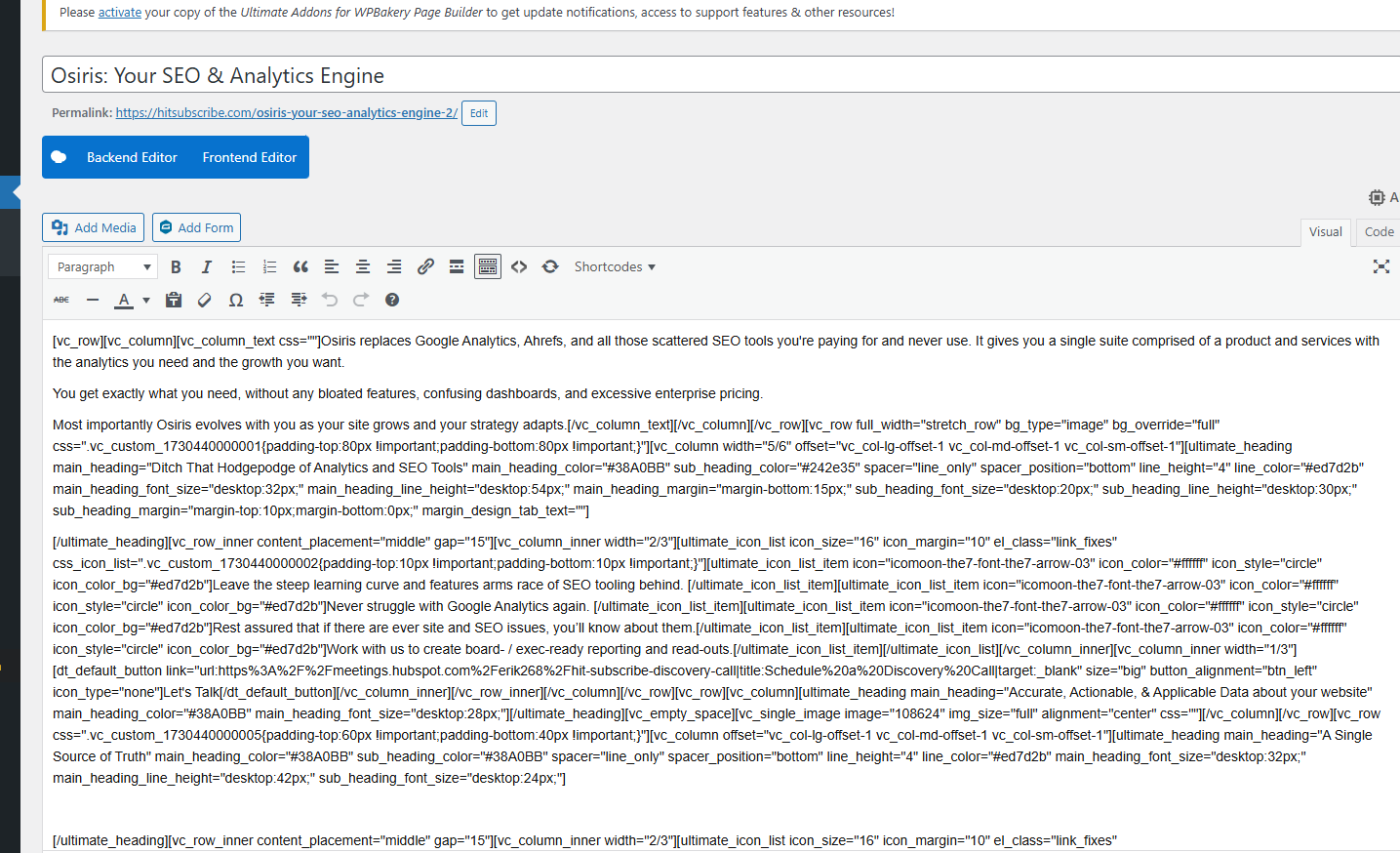
I figured there were probably enough desperate souls on the internet with questions about this that ChatGPT would have decent knowledge of it in its training data. So I described what I want and literally prompted it with “vibe code me up a DIVI page and give it to me in shortcodes I can paste in.” And it worked surprisingly well.
Within half an hour I had something that looked alright-ish. It was another situation where the time to mediocrity was amazingly low, thanks to Gen AI. (As a coda, Lyndsey who does growth for Hit Subscribe and is talented with design eventually took over and created the actual, live Osiris page. I’m not sure how much, if any, vibe-anything she used).
But we’ve got a theme here. I’m not good at UX stuff. I’m not good at Python scripting. But with an LLM I can get to mediocre in minutes, rather than days.
Mean Time to Total Mediocrity
I realize that this is true across the board. I’ve recently used ChatGPT to help fix up an old Sega Genesis, troubleshoot a firepit, and navigate various state labor law bureaucracies. My skill level at all of those things is 0, but with the help of the LLM, I can LARP as mediocre. And heck, with a bit of practice, maybe even ascend to mediocre in earnest.
It makes sense. LLMs train on the wisdom of the internet, such as it is. They then use this wisdom to predict what word the user wants to see next. They are, essentially, an oracle that produces mediocre skill and knowledge instantly, on demand.
LLMs have thus utterly flattened society’s mean time to mediocrity.
But what does this mean, exactly? What does it mean if anyone can immediately be mediocre at anything they want?
What does it mean if a content marketer with no programming aptitude can suddenly simulate being a mediocre programmer? How about if a sales rep forwarding a contract can suddenly decide to be a mediocre paralegal? How about an exec becoming a mediocre version of anyone in the org chart below them to help with micromanagement? It’s all on the table.
At first blush, this seems like it would be largely and unambiguously positive. We can all become “T-shaped” or “specializing generalists” or whatever management buzzword for this is poppin’ these days. If you’re a really good widgeteer, you can still be that, while also bringing universal mediocrity in all other fields to bear, which is certainly a little better than a mix of ineptitude and novicehood that you formerly had.
Considering Possible Downsides
Or is it?
According to a recent study, this capability is starting to produce burnout.
Specifically, because “productivity” and the “variety of tasks they could tackle” increased, people took on more work. So they take on these new responsibilities, at which they’re immediately (and unearned) skill level mediocre. And then.. yeah, huh. Now you’re doing your original job, plus a bunch of other ones that you’re not actually very good at and maybe aren’t quite as awesome as you originally thought when you Mary-Sued your way to mediocrity.
But if we zoom out even more and look at the bigger picture in a corporate workforce, what’s the end game here? Are we going to perform an about-face from millenia of moving towards increased specialization of labor? Is every content marketer going to be a programmer, every salesman a lawyer, and every executive an individual contributor? Should everyone become mediocre at everything?
The Unclear (and Interesting) Future of Labor Specialization
This is genuinely a pretty open-ended question and musing on my part. I don’t intend this as a rhetorical condemnation, and I’m not writing some kind of Swiftian modest proposal. I’m earnestly curious because this capability seems both locally powerful and macroscopically limiting, so I don’t know where it goes.
And, while it’s cool for me to be able to fix Sega Genesis in my spare time with my son, I’m not really sure that medicore web design is the best of use my time in my role for Hit Subscribe. 5 years ago, I wouldn’t have attempted it. But in 2025, I had ChatGPT in an open browser tab, practically egging me on to indulge this side quest, notwisthanding the fact that any competent management consultant would have slapped my hand before I started prompting.
For better or for worse, I’d argue that the main contribution of GenAI / LLMs to date is smashing our collective mean time to mediocrity from days, weeks, or months, to mere minutes. What we as humanity do with our newfound and boundless mediocrity is the open question.
