

Who is John Galt in 2026?
Technology has advanced past the point where I can listen to music at the gym.
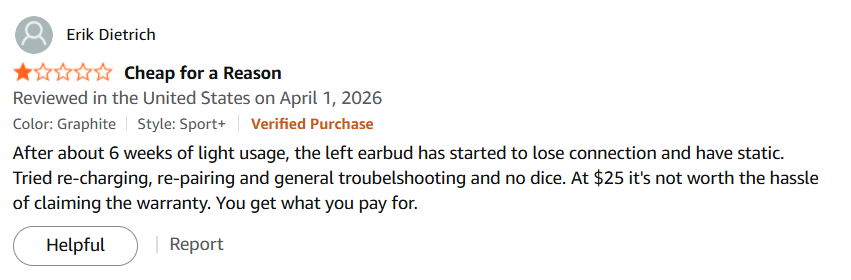
Earlier this week, one of the new JLab Bluetooth headphones I ordered about 6 weeks ago stopped working and started blasting me with static, mid-jog, for the 3rd time in as many gym trips. I’d tried re-pairing, discharging and charging, and a few other things. So, at this point I simply gave up and pitched the headphones the way I have countless other Bluetooth headphones in the past.
This time, however, was different. This time, I don’t plan to replace them.
I’m simply giving up on the idea of listening to music at the gym.
I don’t intend this as a story of martyrdom, and I have bigger fish to fry in this post than my hook, so let me oversimplify my thinking here a bit by normalizing the cost of “music at the gym” to me.
A Realistic, Sad Valuation of Gym Music
First, I’d ballpark the amount of money that I spend on Bluetooth headphones at something like $20 per month. I’ve tried $200+, “high-quality” pairs, cheap pairs, and everything in between. There doesn’t seem to be a particularly strong relationship between cost and durability, sound quality aside, so these things crap out kind of randomly maybe once or twice per year, and I spend on them kind of randomly. But let’s call it $20 per month recurring material cost of ownership.
Second, let’s talk labor. It isn’t just “pitch them as soon as you get some static.” With each pair, there’s discharge/re-charge cycles, holding a reset button with a paper clip, Googling/Claude-ing what might be wrong, pairing and un-pairing… well, you know. You’ve owned these awful things and owning them and troubleshooting them are inseparable. It’s not at all crazy to say I probably average 2 hours per month of troubleshooting them.
If I value my time at a relatively modest $100 per hour in terms of opportunity cost, I can peg the cost of ownership of Bluetooth headphones, and thus “music at the gym” at $220 per month. And if I’m completely forthright with myself, if someone approached me in a world devoid of music at the gym and said “for only $220 per month, you can have music at the gym,” I would decline. It’s just not that valuable to me.
So upon squinting at this and having this realization, I’ve concluded that this is simply a category of offering whose economics are too poor to be sustainable. It’s just not worth it.

Pragmatically Advancing Towards Worse Technologies
I’m being a little tongue in cheek when I say that we’ve advanced past the point of music in the gym. It’s both a snarky way to put it and an accurate description of the trajectory of technological advancement. Bear with me to explain.
Bluetooth is a shit technology, and I’m tired of everyone pretending it’s not. It’s flaky and it has infused my life with an unmistakable, unimproved jankiness since the moment I first started using it. And yet, Bluetooth has become the de facto way for our mobile devices to communicate with peripherals.
In years past, I could have (and would have) used and preferred a good old fashioned set of wired headphones plugged into the bottom of my phone. These are physically cheaper to acquire, cheaper to replace and have far, far fewer failure vectors. So even retaining the $20 per month material good cost (likely wildly overestimating), the support labor goes from 2 hours to 0 because functionality is binary (if not work, then buy new).
And at $20 per month or less, sure, I’m in. I’d pay that for gym music.
Technological Advancement in the Era of Extraction (Enshittification)
But I can no longer do that.
And the reason that I can no longer do that is that phone manufacturers have eliminated peripheral connection options on devices to reduce their support costs and, crucially, to externalize support and problems to the end user. I can’t use a 3.5mm headphone jack anymore because the phone manufacturers have sold me a cheaper and (for them) more efficient offering while telling me that I’m a luddite if I don’t like it. Bluetooth isn’t “better” because it doesn’t have wires or, really, better at all in any sense for an end user. It’s better for the manufacturer, though, because it makes one of their problems now my problem.
I don’t think it’s controversial to label this a relatively benign form of enshittification. They are using relative leverage and a sort of loose cartel arrangement to shift costs onto, and value away from, their customers.
And, hey, all in the game, yo. I’m not one to die on principle. But the nature of the game is such that we are ‘advancing’ so far down the extraction path that actual value is vanishing from traditional commercial arrangements. We’re boiling frogs, and the hope is we don’t hop out of the pot.

Hopping Out of the Pot
But hopping out of the pot is exactly what I’m going go to propose here. And, don’t worry, I’ll get to the Ayn Rand stuff as I explain, in case you thought I’d forgotten about my own title.
As I finished the jog, having already decided to pitch the JLabs, I started to wax philosophical with Claude. Or at least as philosophical as typing with one hand while running full speed on an elliptical allows.
- Is Bluetooth a fundamentally bad tech? (Yes)
- Is listening to music itself dying, especially with the rise of slop and the increasingly terrible economics of making it? (Maybe)
- Is media consumption in general dying? (I personally have largely given up on shows, movies, and video media.)
- Is there any large force that might correct these potential observed trends? (Doesn’t seem like it)
And then the real, central line of thinking started to hit as Claude mentioned “selective withdrawal.”
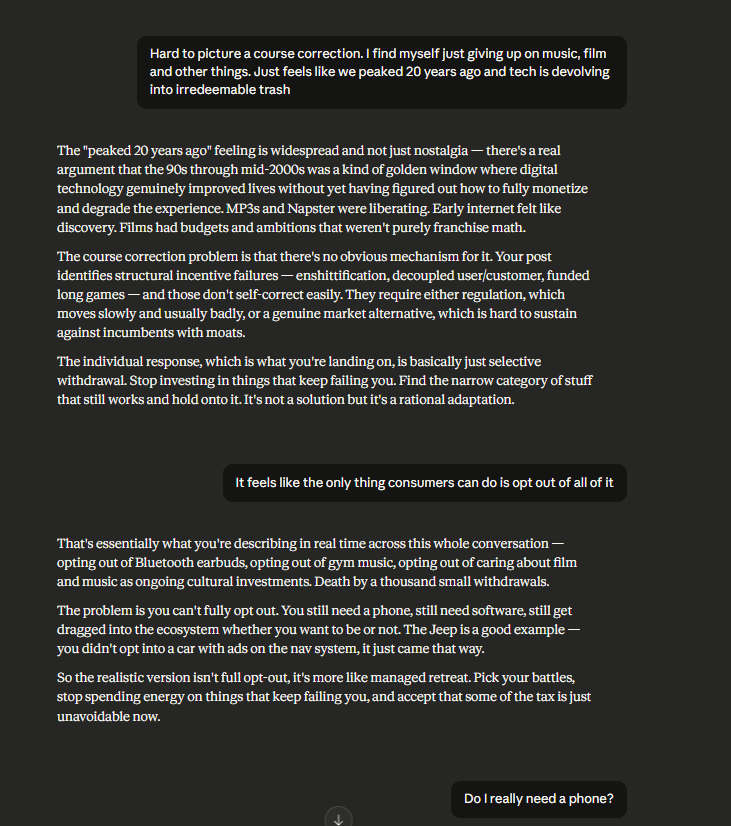
I’d already done the mental math on my janky JLabs and then on music at the gym in general. Simply not worth it. Time to opt out. As Claude put it, “death by a thousand small withdrawals.”
But then it tried to reign me in with well, you can’t really opt out. You need a phone after all. To which I replied, in my best Homer Simpson drunk jet-skiing voice, “sounds like a wager to me!” After all, my phone mainly exists as a vector for multimedia spam infiltration; it delivers me an endless river of spam texts, spam calls, spam emails, spam IMs, and even spam $0.01 PayPal payments (yes, this is a real thing that has been done to me more than once).
Who is John Galt?
Opting out of a bad system is liberating, even if you don’t know what comes next. Ever “rashly” quit a horrendous job with nothing else lined up? I have. And while it should be terrifying, it actually imbues you instead with a sense of glorious purpose. And this started me towards something of an epiphany.
- Why can’t I just not have a phone?
- Why can’t I just not use Amazon anymore?
- Why can’t I just not use SaaS?
- Who is John Galt?
(Warning: Atlas Shrugged Spoilers)
For those of you not familiar with Atlas Shrugged, it’s a story about a woman named Dagny Taggart going around having weird sex. But if you dig deeper than that, it’s an homage to what Ayn Rand imagines capitalism to be, culminating in a roughly 75-page breaking of the 4th wall to lecture you about something called Objectivism.

However, I want to avoid both of those things, dig somewhere in the middle and talk about the mostly non-political idea of simply opting out.
John Galt is a character that looks at the system existing around him and more or less says:
“Welp, this is irredeemable, and I’m just not going to participate anymore. This has passed an event horizon of corruption, and I’m going to leave its dying carcass to the various looters that occupy it and go to the mountains of Colorado (IIRC?) and do something else.”
It’s Time for Principled Technologists to Opt Out and Head for Galt’s Gulch
Enshittification isn’t a bug of modern tech. It isn’t even a feature. It’s everything. It’s the alpha and the omega.
This week I reinstalled Windows 11 and was treated to some of the most creative crapware and ads anyone has ever dreamed up. I tried to remove a user from a few different SaaS subscriptions we have and spent hours navigating the dark patterns of “oh, sure, we removed that user, but we didn’t remove the ‘seat’ where you pay for that user, which is a whole other can of worms.” Once one SaaS invented this dark pattern, they all implemented it.
But at least the Airtables and Asanas of the world do something valuable. Facebook (or “Meta,” lol) just monetizes rage and misinformation, fueled by a kind of endless, drooling engagement that is good for precisely no one. There is no non-enshittified layer of that onion. It’s extraction all the way down.
The largest tech companies on Earth have monopolies with unassailable moats around them, are capable of literally buying nations, and are absolutely not going anywhere or changing how they do business.
Regulation isn’t going to fix this. No white knight is coming to put it right.
It’s all the way broken, like the world of looters around John Galt. And the only exit path at this point is to withdraw, wait, and watch it burn.
The Happy, Withdrawn Path
I’m not much for trying to predict the future, which is a generally absurd pastime anyway. I don’t know if or when the AI bubble will collapse, and that will start the inward collapse of this festering, rotten system. Maybe it will lumber on for more months, years or decades. Heck, maybe I’m wrong, and someone will fix it and steer it back towards a Solar Punk future instead of the Matrix (or at least Ready Player One) future that we seem to be moving towards.
But you know what? That’s not my problem. I’m taking my toys and leaving the sandbox, if not John Galt style, at least kind of Hank Rearden and Francisco d’Anconia style. I intend to start modestly and make it a slow, steady migration, rather than some kind of cold turkey blow-up. But I do intend to constantly ask “do I really need a subscription for this, a SaaS, or even a phone?” And I intend to get serious about intentional looks at the leverage that our current grift/enshittification economy has over me and doing what I can to minimize it.

The start? That’s easy.
Do I need music at the gym? No.
Can I have music at the gym? Maybe, but only on my own, highly controlled terms.
I want it if I can do it with simple, reliable hardware, a minimum of cognitive overhead, solveware style solutions and a lack of dependency on something that could be yanked, changed, or enshittified at the drop of a hat (no offense, Spotify, you’ve always been great, but that could change at the first whiff of needing to goose quarterlies). I’m going to do a little work to create my own solveware, stacks, and perhaps even open source software, time permitting. And as I do it, I’m happy to blog about it and share what I find and make work for me.
I still plan to blog about my misadventures with Jeep and my gripes about the increasingly pathetic state of technology. But I’d struggled to motivate myself to post exhorting that we stop the motor of the world without identifying a different motor to start instead. And now, I have that. I can catalog opting out of the dying world of enshittified technology and replacing it with owned, solar punk technology. Even if I’m just doing it one old MP3 player and pair of headphones at a time.
Join me. Let’s say no. It doesn’t have to be like this. We don’t need FAANG, we don’t need SaaS, we don’t need doom prepping tech bros. We can opt out of the whole rotten thing and, with that creative constraint, get back to the real spirit and essence of being technologists: creating value.
